
This guide draws on my years of experience selecting commercial rotary ovens for large-scale central kitchens. I typically start by confirming production capacity and energy type, then assess temperature control accuracy and automation level, and finally verify material quality and after-sales services.
For mass commercial production, models with 32 to 64 trays are highly recommended. Opt for dual gas and electric power options, units with internal temperature deviation within ±3°C, full 304 stainless steel construction, built-in automatic steam systems and motor-driven trolley mechanisms.
1.Prioritize Production Capacity
The industry standard baking tray measures 400×600mm, with mainstream models available in 16-tray, 32-tray and 64-tray specifications.
The 16-tray oven suits small central kitchens, delivering a daily output of 200 to 300 kilograms and supplying 10 to 15 retail outlets. Compact and energy-efficient, it fits newly established catering businesses.
The 32-tray model stands out as the most cost-effective pick for mid-sized central kitchens. It yields 500 to 800 kilograms daily, ideal for regional catering chains and medium-sized food processing plants.
For large industrial central kitchens or facilities integrated with fully automated production lines, the 64-tray oven is the optimal choice. Boasting a daily capacity of 1.5 to 2 tons, it caters to major catering groups and large-scale food manufacturers.
Match Oven Type to Site Conditions & Operating Costs
Gas-powered ovens rank top choice for most projects. They heat up rapidly, reaching 200°C from room temperature in roughly 10 minutes and incur the lowest long-term operational costs. Gas models deliver maximum continuous production efficiency if natural gas or liquefied gas supply is accessible.
Electric ovens apply to sites under strict environmental regulations with no gas access, such as indoor commercial complexes and enclosed central kitchens. They produce zero smoke and pollution and maintain steady temperature control, yet consume substantial electricity and bring higher long-term running expenses.
Diesel-powered units are only applicable to remote factories with unstable power supply and no gas pipelines. They operate steadily but require proper smoke exhaust treatment.
Evaluate Core Operational Performance
Premium ovens maintain internal temperature fluctuation within ±3°C, while qualified standard models keep deviation under ±5°C, preventing uneven crust coloring and inconsistent batch product quality.
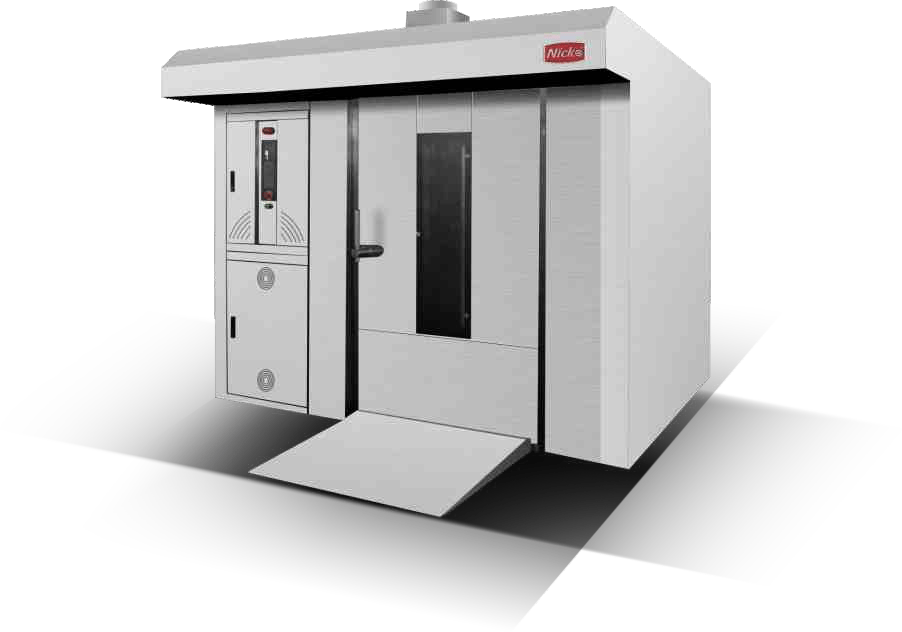
Smart temperature control systems are preferred for precise heat regulation, accurate timing and stable mass production results. The Nicko’s 64-tray rotary oven adopts advanced electric heating and high-precision temperature control systems, delivering consistent heat and humidity to enhance baked goods taste and quality.
Equipped hot air circulation systems ensure even heating across all trays, outperforming traditional deck ovens in productivity.
Built-in steam function is an indispensable feature. Steam creates crisp crusts for artisan bread and baguettes, and stops mooncakes from cracking during baking.
High-end models come with advanced configurations. Fitted with professional digital controllers and six built-in memory banks, the Nicko’s 64-tray oven saves customized baking parameters. Its stable rotating framework, dual motors and dual air ducts paired with variable frequency airflow adjustment offer two fixed speed levels and stepless speed regulation for uniform heat distribution. Adjustable steam output and optional high-power steam generators fulfill moisture retention, crispness enhancement and anti-cracking demands for various pastries, bread and mooncakes. Core burners are sourced from reputable brands Riello and Olympia, while electric components adopt premium Schneider and Siemens parts.
Nicko’s 64-tray rotary oven:https://www.nicko.com.cn/product/nickos-64trays-rotary-oven/
Structure & Material: Durability and Food Safety Compliance
Select ovens with 1.2 to 1.5mm thick food-grade 304 stainless steel inner chambers and bodies. The material resists high heat and corrosion, allows easy cleaning and meets official food safety production standards. The Nicko’s 64-tray oven features robust AISI 304 stainless steel build for durability and effortless maintenance. Avoid 201 stainless steel, which is prone to rust and carries risks of heavy metal leakage.
Insulation layers shall be made of aluminum silicate wool with thickness over 80mm. Standard double-layer tempered glass doors and fully sealed rubber strips preserve heat and enable clear baking observation.
Intelligent Automation
Basic mandatory functions include automatic temperature control, smart timing, fault alert and power-off memory.
Touchscreen control systems are recommended for mid-to-high volume production. Multiple baking formulas can be stored to support standardized chain operation.
Compliance & Safety Mandates for Food Factories
Complete qualification certificates must be inspected prior to procurement. Valid food machinery manufacturing licenses, CE certification and ISO9001 quality management certification serve as basic entry requirements.
Overheat protection, leakage protection, emergency stop buttons and anti-scald designs come as standard features. Gas-fired ovens must be fitted with gas leakage detectors.
Final Inspection Checklist
Verify all items below before placing orders:
✅ Capacity matching: 32-tray for medium output, 64-tray for high-volume production
✅ Energy suitability: Gas type for cost efficiency, electric type for restricted and eco-friendly sites
✅ Uniform heating: 3D hot air rotating system with temperature deviation ≤±3°C
✅ Accurate temperature regulation: PID precise control and multi-stage baking program storage
✅ Qualified materials: Full 304 stainless steel interior and thick high-density insulation
✅ Complete functions: Adjustable automatic steam system and motor-driven trolley system
✅ Safety compliance: Full food-grade certifications and comprehensive safety protection
✅ Reliable after-sales service: Solid warranty and prompt on-site maintenance support
Common Selection Pitfalls to Avoid
Never judge capacity merely by tray quantity; check actual effective baking area instead.
Always conduct on-site temperature tests, as low-cost ovens often have temperature deviation exceeding 10°C.
Refrain from cutting costs by choosing 201 stainless steel materials.
Do not overlook steam function, a core requirement for mainstream baked products.