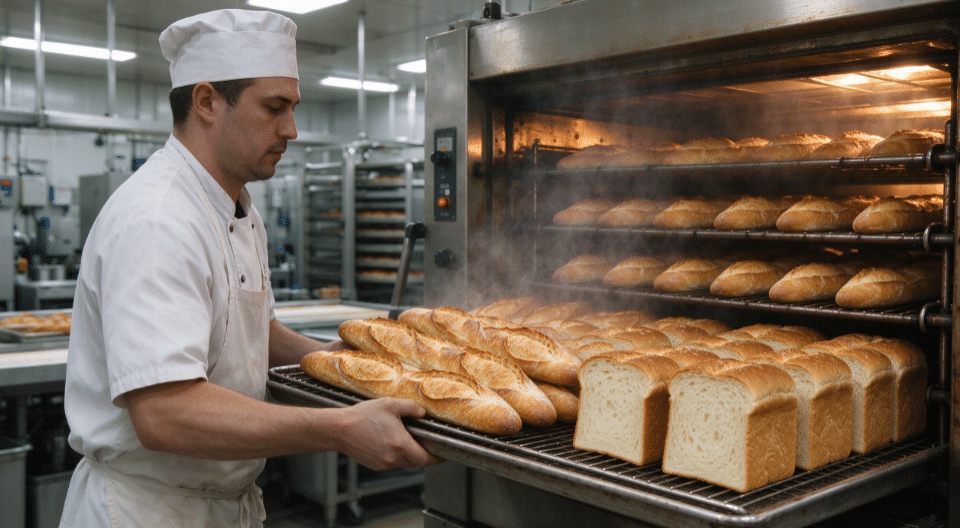

Rotary hot-air rack ovens are staple equipment for mid-to-large baking factories and central production kitchens for bakery chains. Bakeries at Sam’s Club and Costco rely on these ovens daily to bake baguettes and high volumes of sandwich loaves. Models fitted with smart digital control panels—hook-style rotary rack ovens in particular—let operators simply tap presets labelled “Baguette Mode” or “Loaf Mode” to run fully standardised bake cycles automatically.
What makes rotary hot-air rack ovens ideal for this work is their 360° rotating rack and recirculating hot-air system, which delivers exceptionally even cavity temperatures for consistent flavour and texture. Conventional deck ovens work well for artisan European-style crusty breads, yet without full 360° rotation, heat distribution is uneven. Bakers must manually rotate trays mid-bake, and results depend heavily on individual skill and experience.
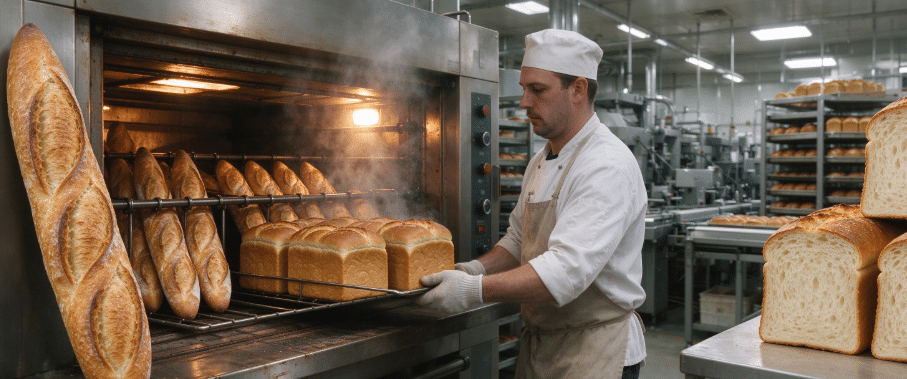
Different baked goods call for distinct baking profiles. How do you dial in the right settings on a single oven? The answer lies in matching oven parameters to each product’s unique requirements. This guide shares professional baking tips and rotary oven selection advice tailored to two very different products: baguettes and lidded sandwich loaves.
1. Baking Characteristics & Technical Requirements for Baguettes and Loaves
Baguettes
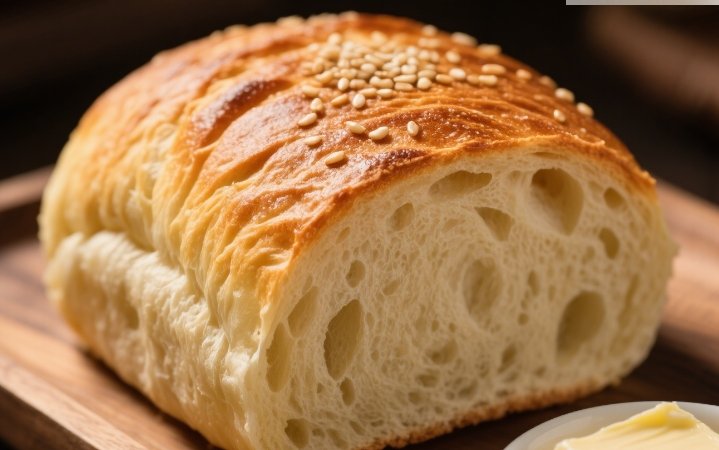
Pastry professionals agree that a well-made baguette features a crisp crust, tender crumb, an open alveolar structure and dramatic scoring splits known as “ears”. This effect depends on rapid surface moisture evaporation and fast dough setting at high heat.
The signature ear formation and large, irregular crumb holes develop as moisture inside the dough vaporises and yeast undergoes its final vigorous expansion. Within seconds after loading, the dough needs a dense burst of superheated steam. Steam condenses on the surface to delay premature skin formation and hardening. It also gelatinises surface starch, creating that thin, amber-gold crust once the loaf exits the oven. If the blower runs at high speed while steam is injected, powerful circulating air disperses the steam instantly. The baguette skin sets too early, and the scored cuts fail to bloom open.
Oven requirements for baguettes: A high-capacity steam generator and extremely fast temperature recovery after loading.
Lidded Sandwich Loaves
A perfect sandwich loaf boasts uniform rise, well-retained moisture, a soft, tight crumb and even browning across all four corners. This requires penetrating, gentle thermal convection and an extended bake at steady moderate temperatures.
Loaf tins are deep and hold a large mass of dough, which conducts heat slowly through its centre. Excessive airflow can scorch the crust while leaving the centre underbaked, or create patchy colouring on the corners of lidded tins. Baking loaves calls for soft, stable convection that transfers heat evenly to the base and sides of each tin while locking in internal moisture.
Oven requirements for sandwich loaves: Multi-stage variable fan speed and finely tuned ducting to prevent aggressive airflow from collapsing the dough.
Oven Recommendation
Baking loaves demands heat penetration deep into closed tins, gentle moderate-temperature convection, adjustable airflow to avoid burnt crusts and raw centres, and outstanding temperature uniformity.
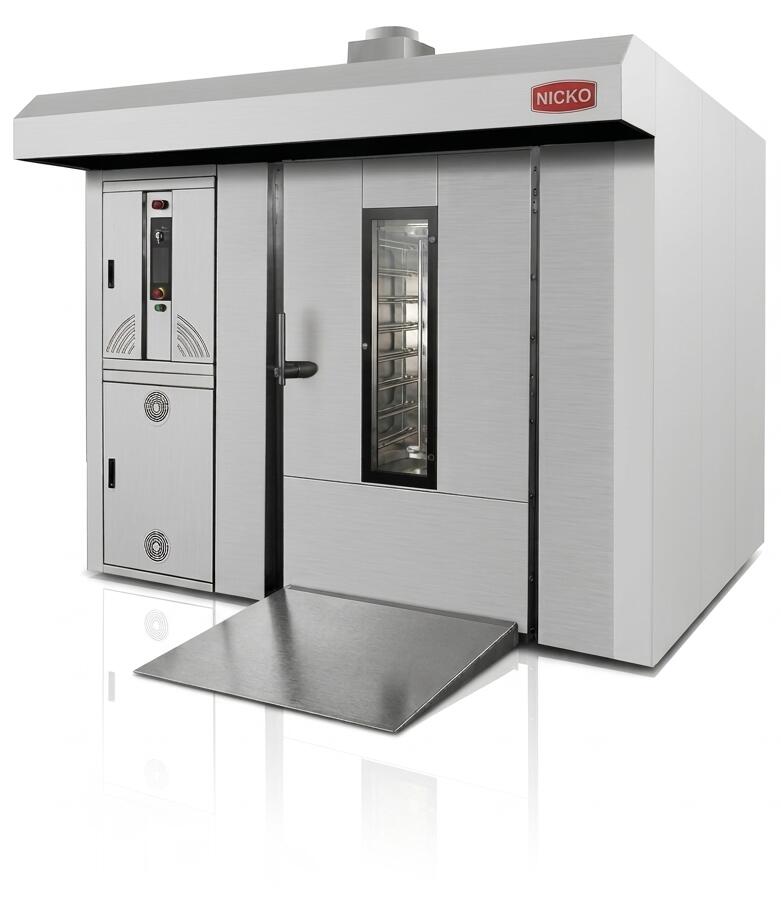
The Nicko’s 64-tray Rotary Rack Oven https://www.nicko.com.cn/product/nickos-64trays-rotary-oven/ checks every box:
- Variable-frequency or dual-speed fan control Loaf tins are bulky and obstruct airflow. When baking loaves, the Nicko oven can be switched to medium-low speed or run the VFD fan at reduced RPM, delivering soft, stable convection. This eliminates dough collapse and uneven corner browning caused by harsh high-velocity air.
- Dual-motor, dual-duct design with 2.0 mm adjustable air baffles Dual air channels paired with adjustable baffles precisely distribute airflow across all 16 rack levels (64 trays). There are no hot or cold zones anywhere on the rack, so every loaf rises evenly and develops identical corner colouration.
- Floor-mounted turntable rotation (heavy-duty, stable operation) A full 64-tray load of loaves is extremely heavy. Bottom turntable designs support greater weight and maintain a lower centre of gravity compared to overhead hook-style racks. Rotation stays smooth and vibration-free, preventing dough collapse during the 360° cycle.
- Robust heat source and premium thermal insulation The Nicko’s 64-tray Rotary Rack Oven uses Riello burners for precise temperature regulation. Its 150 mm thick insulation retains heat reliably, sustaining the steady moderate-temperature environment loaves require for longer bake cycles.
2. Parameter & Selection Reference Table
| Evaluation Metric | Baguette | Lidded Sandwich Loaf |
|---|---|---|
| Core Temperature Range | 220°C – 240°C | 180°C – 200°C |
| Steam Requirement | High (saturated steam burst, 3–8 seconds) | Low / None |
| Fan Speed Profile | Medium-high (fast set and scoring bloom) | Medium (gentle penetration through tins) |
| Critical Hardware | High-thermal-mass steam trough + rapid temperature recovery system | Multi-level adjustable air outlets + balanced, stable thermal field |
| Recommended Rack & Tray Spec | 16-tray / 32-tray rack with wavy baguette trays | 16-tray / 32-tray heavy-duty rack for loaf tins |