
Rising energy prices and fluctuating labour costs are pressing concerns across the commercial baking sector. Flowers Foods, a major food manufacturer, has publicly noted in its financial filings that combined production costs including labour, raw materials and packaging keep climbing, continuously squeezing the company’s net sales margin.
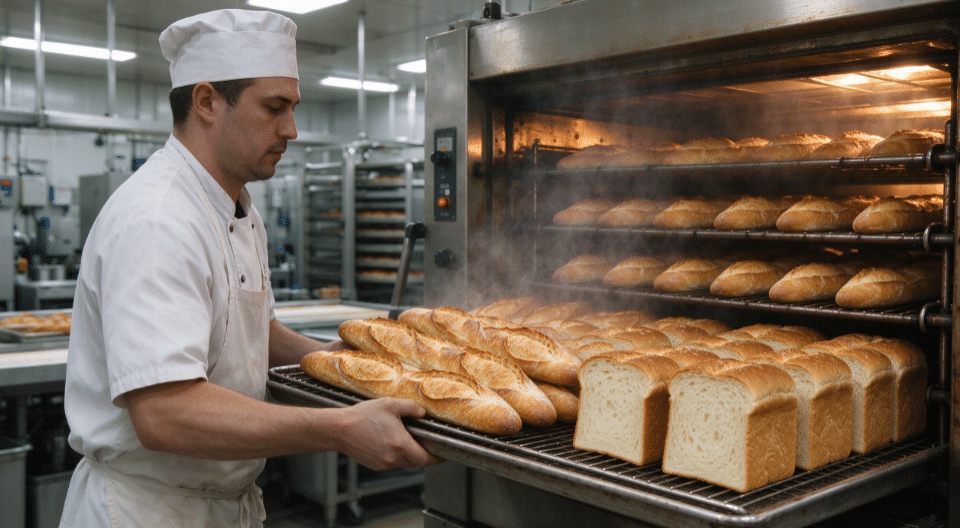
Traditionally, baking operations relied heavily on bakers’ experience and in-house management, lacking standardised workflows. Outdated ovens with high energy consumption were widely used — ovens typically account for 40% to 60% of a bakery’s total energy use, making them the single largest energy consumer, with bread baking carrying a unit energy footprint of roughly 3.7–4 MJ/kg. This legacy equipment can barely help businesses boost profitability. For mid-to-large bakeries, branded chains and central production facilities aiming to maintain consistent product quality while cutting long-term operational expenses, investing in an industrial rack oven engineered for precision smart control and superior energy efficiency is a worthwhile move.
So when exactly does this type of equipment become necessary? What core criteria should you evaluate during procurement? This buying guide breaks down everything you need to know about selecting a precision-controlled, energy-efficient industrial rack oven.
I. When Do You Need a Precision Smart-Control, Energy-Saving Rack Oven?
1. Multi-location bakery chains or central production plants (to eliminate flavour inconsistencies)
The biggest pain point for expanding bakery chains is inconsistent product taste across outlets. Manual oven adjustments dependent on staff expertise lead to unstable bake quality. Industrial-grade ovens paired with standardised training are essential to enable consistent, repeatable production.
For instance, Glockenbrot-Bäckerei, a German bakery under the Rewe Group, runs a large central production facility turning out around 450 tonnes of baked goods daily on modern production lines. Bimbo Bakeries USA, the US arm of Grupo Bimbo and America’s largest baking firm, operates dozens of factories supplying brands including Sara Lee, Thomas’ and Entenmann’s with nationwide distribution — its operation hinges entirely on centralised, standardised production and purpose-built equipment.
2. Specialist craft bakeries focusing on premium artisan sourdough and sandwich loaves
Artisan sourdough and sandwich bread demand tight control over chamber temperature, humidity, hot air velocity and steam injection. Even a 1°C temperature drift or uneven airflow can drastically disrupt loaf expansion and crust crispness.
Bakeries positioned at the premium end must use ovens with high-accuracy thermal regulation. Bäckerei Treiber in Steinenbronn, Germany, for example, blends traditional craft with modern machinery, using advanced ovens to produce specialty sourdough and spelt bread. Tromsø Bakeri in Norway runs a semi-industrial specialist bakery, relying on large rack ovens to produce high-quality fresh bread and pastries.
3. High-throughput production workshops running extended operating hours
Industrial ovens often operate for more than ten hours per day, with gas or electricity bills forming a major monthly overhead. Poor insulation and low thermal efficiency mean constant wasted heat, locking in inflated running costs.
This pattern is well established across Europe (especially Germany and the Nordic countries) and North America. National-scale industrial baking leaders such as Bimbo and Flowers Foods, along with chain central kitchens, follow this same trajectory: as scale grows, operators upgrade to industrial rack ovens featuring programmable recipe controls, heavy-duty insulation and energy-saving design.
II. Core Selection Criteria for Industrial Rack Ovens with Precision Smart Control & High Energy Efficiency
1. Control system with independent multi-phase programming
A high-performance rack oven should split a single baking cycle into discrete phases, each with customisable temperature, duration, exhaust and steam injection settings. Recipe storage functionality is ideal, so teams across sites or shifts can recall standard bake profiles with one touch.
Nicko’s, a leading oven manufacturer based in Guangzhou, China, builds this capability into its R-Series. The integrated smart programming platform stores up to 99 recipes, with each recipe configurable across 8 independent phases — time, temperature, steam injection cycles, exhaust and intake air are all adjustable separately. Recipes can also be authored in ODS files (with BMP/GIF image support) and uploaded via USB drive.

2. Thermal efficiency and insulation construction
Prioritise the heat exchanger design, which directly governs thermal performance and temperature stability. Insulation thickness and density are equally critical: look for insulation at 100 mm or thicker, with additional reinforcement on the oven ceiling, plus dedicated energy-saving operating modes to retain chamber heat.
The Nicko’s R-Series uses an Advanced Cross-Line Heat Exchanger to optimise thermal efficiency and maintain precise temperature control. Its enclosure is lined with high-density 120K insulation wool, 100 mm thick on the main body and boosted to 120 mm on the oven ceiling.
3. Robust convection and steam delivery systems
The hallmark of a premium rack oven is balanced rack rotation and uniform airflow. Full-chamber convection eliminates hot spots, delivering even browning across every batch. Fast, high-volume steam release is another non-negotiable feature.
The Nicko’s R-Series is fitted with Total Convection Control and its High Volume Steam Injection system. This proprietary steam solution delivers exceptional performance: it discharges 7 litres of steam in just 20 seconds, even at chamber temperatures up to 250°C.
4. Reliable build materials and streamlined installation
Constant high-temperature cycling means the gauge of stainless steel used for the oven liner and outer casing directly determines service life. Equally important is modular construction that simplifies on-site assembly and commissioning, avoiding lengthy delays that hold up new store openings.
Some models feature premium grade 201 stainless steel for both inner and outer shells, with a 1.5 mm thick inner liner and 1.0 mm outer panel. A Wedge-Lock System enables engineering teams to complete full assembly and commissioning within a matter of hours.